
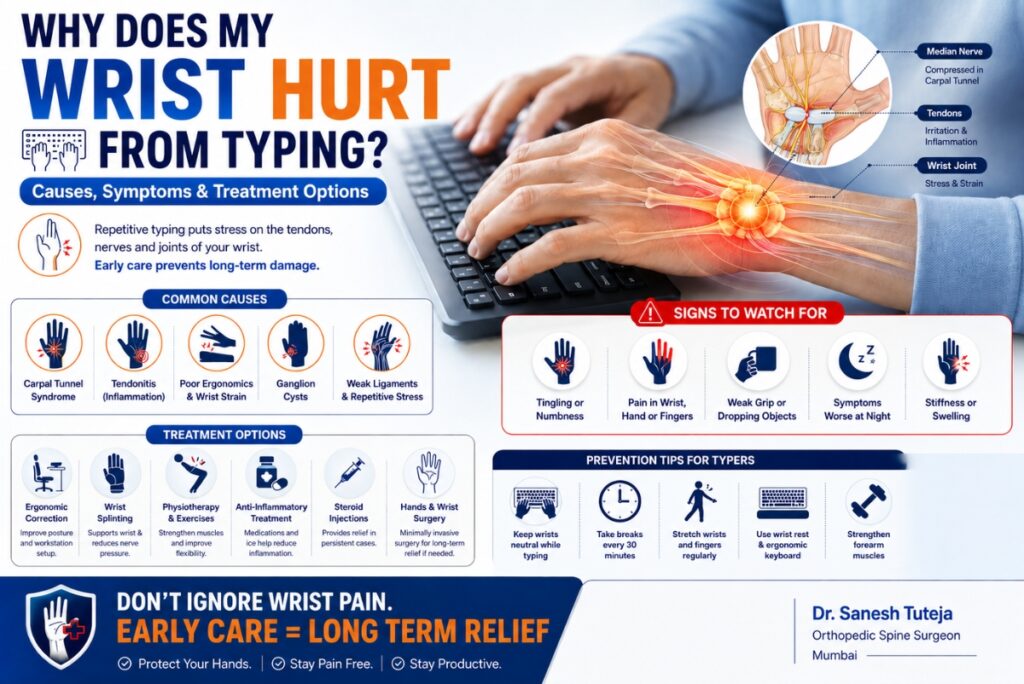
Why Does My Wrist Hurt After Typing All Day?
By 4 PM, your wrist feels like it’s had enough. There’s a dull ache running along the base of your palm, maybe a tingling sensation in your fingers, and reaching for your coffee cup suddenly requires a moment of consideration.
If this sounds familiar, you’re far from alone. With most office jobs now built almost entirely around a keyboard and screen, wrist pain has quietly become one of the most common complaints among working professionals in Mumbai. What starts as mild end-of-day discomfort can, over months, develop into something that interferes with sleep, grip strength, and even simple daily tasks like buttoning a shirt or holding a phone.
Most people manage this with a wrist rest, the occasional stretch, and hope that it eventually goes away on its own. Sometimes it does. But for a significant number of patients, ignoring it long enough eventually leads them to ask whether they need hands & wrist surgery, a question that, with the right early information, many could have avoided altogether.
As an orthopedic specialist who treats hand and wrist conditions regularly, Dr. Sanesh Tuteja explains exactly what’s happening inside your wrist after long hours of typing, what the warning signs actually mean, and what you can do before reaching the point of needing surgical intervention.
What's Actually Happening Inside Your Wrist When You Type
Typing looks like a simple, low-effort movement. Mechanically, it isn’t.
Every keystroke involves small, repetitive movements of the fingers, combined with sustained tension in the wrist and forearm muscles needed to hold your hand in position over the keyboard. Multiply that by thousands of keystrokes a day, hour after hour, and the cumulative load on the tendons, nerves, and joints of the wrist becomes significant.
The structures most affected by prolonged typing include:
- The median nerve, which passes through a narrow tunnel in the wrist called the carpal tunnel, supplying sensation to the thumb, index, middle, and part of the ring finger
- The flexor tendons, which run from the forearm through the wrist to control finger movement, and which can become irritated or inflamed with repetitive use
- The wrist joint itself, particularly when typing is done with the wrist bent upward or downward rather than in a neutral position
- The small stabilising ligaments of the wrist, which can become strained from sustained, awkward positioning over many hours
When any of these structures are placed under repetitive stress without adequate recovery time, the result is inflammation, irritation, and eventually pain.
Common Causes of Wrist Pain From Typing
Carpal Tunnel Syndrome : This is one of the most frequent causes of wrist pain in people who type extensively. The carpal tunnel is a narrow passageway on the palm side of the wrist through which the median nerve travels. Repetitive wrist movement, particularly with the wrist bent, can cause swelling of the surrounding tendons, which compresses the nerve within this confined space.
Tendinitis (Tendon Inflammation) : Repetitive finger and wrist movement can inflame the tendons that control finger and wrist motion, a condition known as tendinitis. This typically causes localized pain, especially along the top or side of the wrist, that worsens with continued use.
Wrist Strain From Poor Ergonomics : Sometimes the issue isn’t a specific structure being damaged but a wrist held in a poor position for too long. Typing with the wrist bent upward (extension) or resting heavily on a hard surface places ongoing mechanical strain on the joint and surrounding soft tissue.
Ganglion Cysts : Less commonly, a small, fluid-filled lump can develop on the wrist, often near the back of the hand. While usually painless, a ganglion cyst can sometimes press on nearby nerves or restrict movement, contributing to discomfort during repetitive activity like typing.
Recognising the Symptoms - From Mild to Concerning
- Early, Mild Symptoms
- A dull ache along the wrist that appears after extended typing sessions
- Mild stiffness when first starting to type in the morning
- Occasional tingling in the fingers that resolves quickly with rest
- Symptoms That Suggest Nerve Involvement
- Numbness or tingling specifically in the thumb, index, and middle fingers
- Symptoms that worsen at night, sometimes waking you from sleep
- A sensation of weakness when gripping objects, like a cup or a doorknob
- Dropping small objects unexpectedly due to reduced hand coordination
- Symptoms Suggesting a More Established Problem
- Persistent pain that no longer resolves with rest or a break from typing
- Visible swelling around the wrist or base of the thumb
- Reduced range of motion when bending the wrist
- Pain that radiates up into the forearm
If you’re noticing symptoms from the second or third group, this is your wrist signaling that the issue has moved beyond simple fatigue and needs a proper evaluation.
Who Is Most at Risk?
Certain factors make wrist problems from typing more likely to develop and more likely to progress if ignored:
- Typing for more than 4-6 hours daily without regular breaks
- Poor workstation ergonomics , keyboard too high, no wrist support, screen positioned awkwardly
- Existing conditions like diabetes, hypothyroidism, or rheumatoid arthritis, which increase susceptibility to nerve compression
- Pregnancy, due to fluid retention that can increase pressure within the carpal tunnel
- Previous wrist injury, including old fractures or sprains that altered the joint’s normal mechanics
- Other repetitive hand activities outside of work, such as certain sports, instruments, or hobbies that add to overall hand strain
If several of these apply to you alongside ongoing wrist discomfort, it’s worth taking the symptoms seriously rather than waiting for them to resolve on their own.
Treatment Options - From Simple Adjustments to Surgical Care
The encouraging news is that the majority of typing-related wrist pain responds very well to conservative treatment, particularly when addressed early.
Activity Modification and Ergonomic Correction : Often the single most effective first step. Adjusting keyboard height, using a wrist rest that supports a neutral position, and taking regular breaks can resolve mild to moderate symptoms without any other intervention.
Splinting : A wrist splint, particularly worn at night, keeps the wrist in a neutral position and reduces pressure on the median nerve. This is especially effective for early carpal tunnel syndrome and is often the first treatment recommended.
Physiotherapy and Targeted Exercises : Stretching and strengthening exercises for the forearm and wrist muscles improve flexibility, correct movement patterns, and reduce the strain placed on tendons and nerves during repetitive activity.
Anti-Inflammatory Treatment : For tendinitis and similar inflammatory conditions, a short course of anti-inflammatory medication, combined with rest and ice, can settle symptoms while longer-term changes take effect.
Steroid Injections : For persistent inflammation around the median nerve or affected tendons, a targeted steroid injection can provide significant relief, often allowing other treatments to be more effective.
Hands & Wrist Surgery – When Conservative Care Isn’t Enough : For patients with confirmed carpal tunnel syndrome that hasn’t responded to conservative treatment or more advanced tendon problems, hands and wrist surgery can provide lasting relief. Modern surgical techniques for conditions like carpal tunnel release are minimally invasive, performed through small incisions, and typically allow patients to return to normal activity faster than older surgical approaches. Surgery is recommended only after appropriate non-surgical options have been properly explored.
Why Early Treatment Makes a Genuine Difference
Wrist problems, particularly those involving nerve compression, tend to follow a predictable pattern: the longer the underlying compression or inflammation continues, the more difficult it becomes to fully reverse.
Early evaluation and treatment typically allow for:
- Resolution of symptoms through simple ergonomic and lifestyle changes alone
- Prevention of permanent nerve damage in cases of carpal tunnel syndrome
- Avoidance of surgery altogether in the majority of cases
- Faster, more complete recovery when treatment is needed
- Protection of grip strength and hand function for daily and professional activities
If you’ve noticed any numbness or tingling that persists, this is the body’s clearest signal that early intervention matters.
Practical Prevention Tips for People Who Type All Day
- Keep your wrist in a neutral position, not bent up or down, while typing. A slight downward slope from elbow to fingers is ideal.
- Use a keyboard and mouse setup that supports your wrists, rather than letting them rest on a hard desk edge.
- Take a one-to-two-minute break every 30 minutes to stretch your fingers, wrists, and forearms.
- Try simple wrist stretches: extend one arm in front of you, gently pull the fingers back with the other hand, hold for 15-20 seconds, then repeat with the palm facing the other direction.
- Strengthen your forearm muscles with light resistance exercises a few times a week; stronger muscles better support the tendons and joints during repetitive activity.
- Avoid resting your wrist on a hard surface for extended periods; a soft wrist pad reduces pressure on the underlying nerve and tendons.
Your Wrists Carry More Than You Realise -Take the Ache Seriously
It’s easy to dismiss wrist pain as just another minor side effect of a demanding job. But the wrist is a small, intricate structure carrying a disproportionate amount of daily strain, and the discomfort it sends your way is rarely without a reason.
The good news is that most typing-related wrist problems, caught early, resolve completely with simple changes, better ergonomics, the right stretches, and a bit of rest. The smaller number of cases that need more treatment options, ranging from splinting to hand & wrist surgery in Mumbai, are available, effective, and far less daunting than most patients expect.
Dr. Sanesh Tuteja offers expert, patient-centered care for hand and wrist conditions, helping working professionals across Mumbai protect their hand function and get back to pain-free typing, gripping, and daily living.