
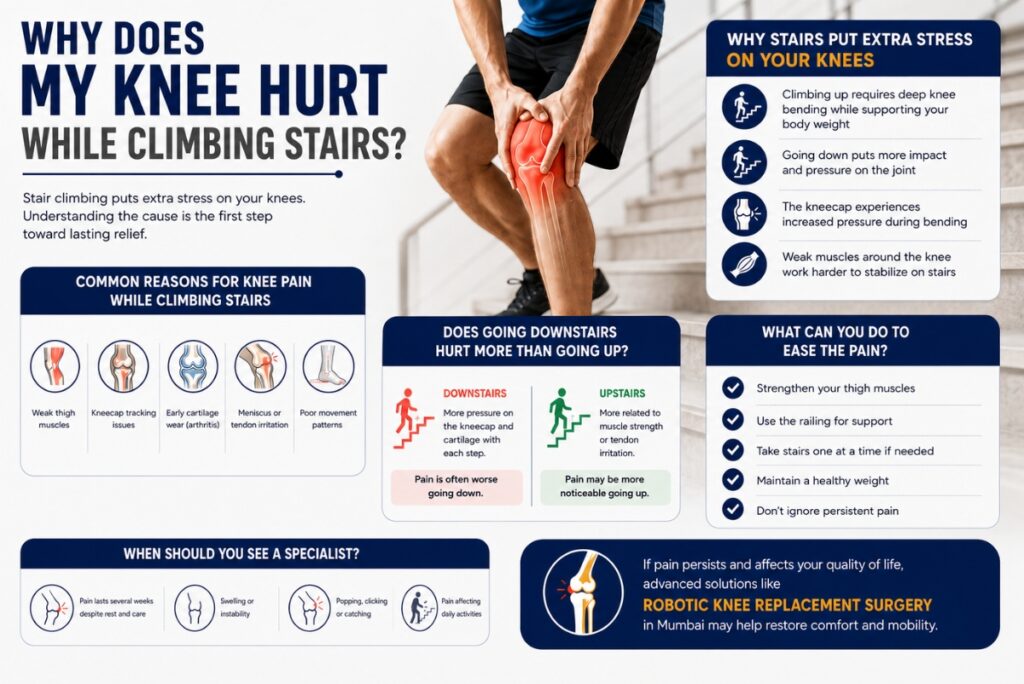
Why Does My Knee Hurt While Climbing Stairs?
You’re heading up to your apartment, or maybe climbing the stairs at work because the lift is taking forever, and there it is, that familiar twinge in your knee. Going down often feels even worse than going up. If this happens regularly, it’s not something to just accept as “normal” it’s usually your knee telling you something specific is going on.
Let’s break down why stairs seem to trigger knee pain so often and what it might mean.
Why Do Stairs Put So Much Extra Stress on Your Knees?
Stairs aren’t just walking with an incline they place significantly more load on your knees than flat-ground walking.
- Climbing up requires your knee to bend deeply while supporting your full body weight
- Going down puts even more stress on the joint, as your knee absorbs the impact of each step
- The kneecap experiences increased pressure against the joint underneath it during bending
- Weak muscles around the knee have to work harder to stabilize the joint on stairs compared to flat ground
This is exactly why so many people who don’t notice knee discomfort during normal walking suddenly feel it the moment stairs are involved.
What Are the Common Reasons Knees Hurt While Climbing Stairs?
There isn’t just one single cause several different issues can lead to this specific kind of pain. Some of the most common ones include
- Weak thigh muscles If your quadriceps (the muscles at the front of your thigh) aren’t strong enough, your kneecap doesn’t track smoothly, leading to pain, especially on stairs.
- Kneecap tracking issues Sometimes the kneecap doesn’t glide properly within its groove, causing friction and discomfort, particularly with bending movements like climbing.
- Early cartilage wear (osteoarthritis) As cartilage naturally thins with age or repetitive use, stairs often become one of the first activities to trigger noticeable discomfort.
- Meniscus irritation The cushioning cartilage in the knee can become irritated or torn, often causing pain specifically with bending or twisting movements like stair climbing.
- Tendon irritation Tendons around the knee, especially the one connecting the kneecap to the shin bone, can become inflamed from repetitive stress, causing pain during bending activities.
- Poor movement patterns Sometimes it’s less about the knee itself and more about how the hips and ankles move, which can shift extra stress onto the knee joint.
Is Knee Pain on Stairs Always Linked to Arthritis?
Not necessarily, though it’s a common assumption, especially in people over 40. A few relatable clues help differentiate:
- Arthritis-related pain often comes with morning stiffness, gradually worsens over months or years, and may include a grinding sensation
- Muscle-related pain tends to improve significantly with strengthening exercises and is often linked to overall leg fatigue
- Structural issues like meniscus tears usually involve a specific triggering movement, sometimes with clicking or catching sensations
If your knee pain came on gradually over a long period, arthritis becomes more likely. If it started suddenly, especially after an injury, a structural issue is more likely.
Does Going Downstairs Hurt More Than Going Upstairs?
For many people, yes and there’s a clear reason why. Going downstairs requires your knee to absorb and control your body weight with each step, putting significantly more pressure on the kneecap and surrounding cartilage compared to going up.
- Pain that’s worse specifically going downstairs often points toward kneecap-related issues
- Pain that’s more noticeable going upstairs may be more related to muscle strength or tendon irritation
This distinction can actually be a genuinely useful clue when describing your symptoms to a specialist.
What Can You Do to Ease Knee Pain While Climbing Stairs?
A few practical strategies can help reduce discomfort in the meantime:
- Strengthen your thigh muscles – Simple exercises like straight leg raises can help support the knee joint
- Use the railing – Taking some of the load off the knee while climbing can reduce strain
- Take stairs one at a time if needed – Rather than pushing through pain, especially on bad days
- Maintain a healthy weight – Reducing excess load on the knee joint significantly eases stress with each step
- Avoid ignoring persistent discomfort – Continuing to push through pain repeatedly can worsen underlying issues over time
When Should You See a Specialist for Stair-Related Knee Pain?
It’s worth getting a proper evaluation if you notice:
- Pain that’s been present for several weeks despite rest and basic care
- Swelling around the knee that isn’t settling down
- A popping, clicking, or catching sensation with movement
- Noticeable weakness or a feeling that the knee might give way
- Pain that’s significantly affecting your daily mobility, like avoiding stairs altogether
In more advanced cases, especially where cartilage has worn down significantly and conservative treatments haven’t helped, your doctor may discuss more definitive options including robotic knee replacement surgery as a way to restore comfortable movement long-term.
Final Thoughts
Knee pain while climbing stairs is common, but it’s rarely something you simply have to live with. As Dr. Sanesh Tuteja often tells patients, understanding exactly when and how the pain shows up going up versus down, gradual versus sudden makes a real difference in identifying the right treatment early. If stair climbing has become genuinely difficult or painful, and conservative treatments haven’t helped, exploring your options with a specialist offering robotic knee replacement surgery in Mumbai can help you understand whether it’s the right path for lasting relief and comfortable movement.