
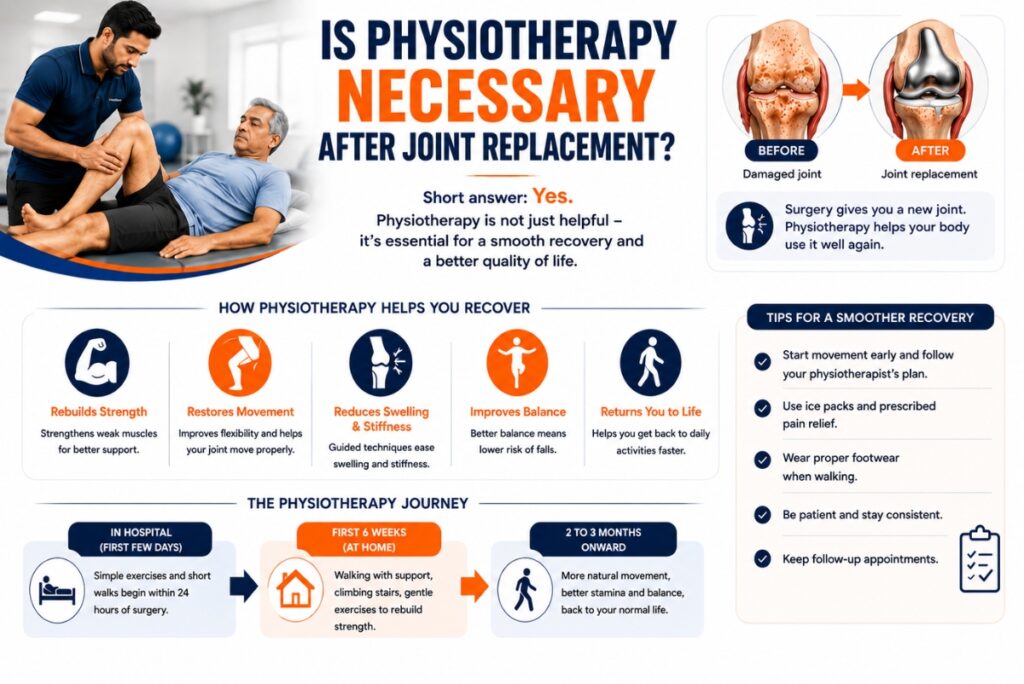
Is Physiotherapy Necessary After Joint Replacement?
So, you’ve just had (or you’re about to have) a joint replacement surgery. First of all, good for you for taking that step. Whether it’s your knee or your hip, joint replacement can genuinely give you your life back. But here’s a question almost every patient asks at some point: “Do I really need physiotherapy after this, or will I heal fine on my own?”
It’s a fair question. And the honest answer is yes, physiotherapy isn’t just helpful; it’s essential. Let’s talk about why, in the simplest way possible.
What Actually Happens to Your Body During Joint Replacement?
During surgery, your damaged joint (usually a knee or hip) is replaced with an artificial one made of metal, plastic, or ceramic. Sounds simple, but think about what your body goes through:
- Muscles around the joint get cut or stretched during the procedure
- The tissues need time to heal and reconnect
- Your body has been “protecting” that painful joint for months or years, so your muscles have likely gotten weak and lazy
- Your brain has also unlearned how to move that joint normally
So even though the new joint itself may be perfectly fine right after surgery, your body doesn’t automatically know how to use it well. That’s where physiotherapy steps in.
Why Is Physiotherapy So Important After Surgery?
Think of it this way: getting a new joint is like putting a brand-new car engine into an old car. The engine works great, but if the wheels, brakes, and steering aren’t aligned properly, the car still won’t drive smoothly. Physiotherapy is what aligns everything.
Here’s what it actually does for you:
- Rebuilds strength in muscles that weakened before surgery
- Restores movement so your joint can bend, straighten, and rotate properly
- Reduces swelling and stiffness through guided movement and techniques
- Improves balance, lowering your risk of falls
- Speeds up your return to daily activities like walking, climbing stairs, or even driving
- Prevents long-term complications such as stiffness that never fully goes away
Without physiotherapy, many patients end up with a joint that “works” but doesn’t move as freely as it should. You might always walk with a slight limp or never fully straighten your knee again, not because the surgery failed, but because the muscles and movement patterns around it were never retrained.
What Does the Physiotherapy Journey Actually Look Like?
You don’t need to imagine some intense gym routine. It’s gradual, and your physiotherapist adjusts it to your pace.
In the hospital (first few days): Simple movements like ankle pumps, gentle knee bends, and short assisted walks begin almost immediately, often within 24 hours of surgery. This early movement is one of the biggest factors in a smooth recovery.
First 6 weeks at home: This is when most of the real work happens—walking with support, climbing a few stairs, gentle stretching, and exercises to rebuild strength.
2 to 3 months onward: Movement becomes more natural, and exercises focus on building stamina, balance, and getting back to normal life cooking, walking outside, and even light travel.
Every recovery timeline is a little different, and that’s completely normal. Your body isn’t a machine on a fixed schedule.
Can You Just Skip Physiotherapy If You're Feeling Fine?
This is where a lot of people get it wrong. Feeling “okay” a few days after surgery doesn’t mean your joint has regained its full strength or range of motion. Skipping physiotherapy often leads to:
- Permanent stiffness
- Muscle weakness that never fully recovers
- Longer-term pain during daily movements
- A higher chance of needing further treatment later
Physiotherapy isn’t a “nice-to-have” add-on; it’s really the second half of the treatment, not an optional extra.
Practical Tips for a Smoother Recovery
- Start movement early, even if it feels uncomfortable at first
- Follow your physiotherapist’s plan consistently, not just when you “feel like it.”
- Use ice packs and prescribed pain relief to stay comfortable during exercises
- Wear proper footwear when walking
- Be patient real progress often shows up in weeks, not days
- Keep follow-up appointments so your recovery can be tracked properly
If you’re exploring your options for joint replacement surgery in Mumbai, it’s worth choosing a team that treats physiotherapy as part of the surgical plan, not something you figure out afterward on your own.
Final Thoughts
Joint replacement surgery gives you a new joint, but physiotherapy is what teaches your body how to actually use it well again. Skipping it is a bit like buying a new phone and never updating the software. The hardware is great, but it won’t perform at its best.
As Dr. Sanesh Tuteja often reminds his patients, the surgery is only one part of the recovery story consistent physiotherapy is what truly determines how well and how quickly you get back to your normal, active life.