
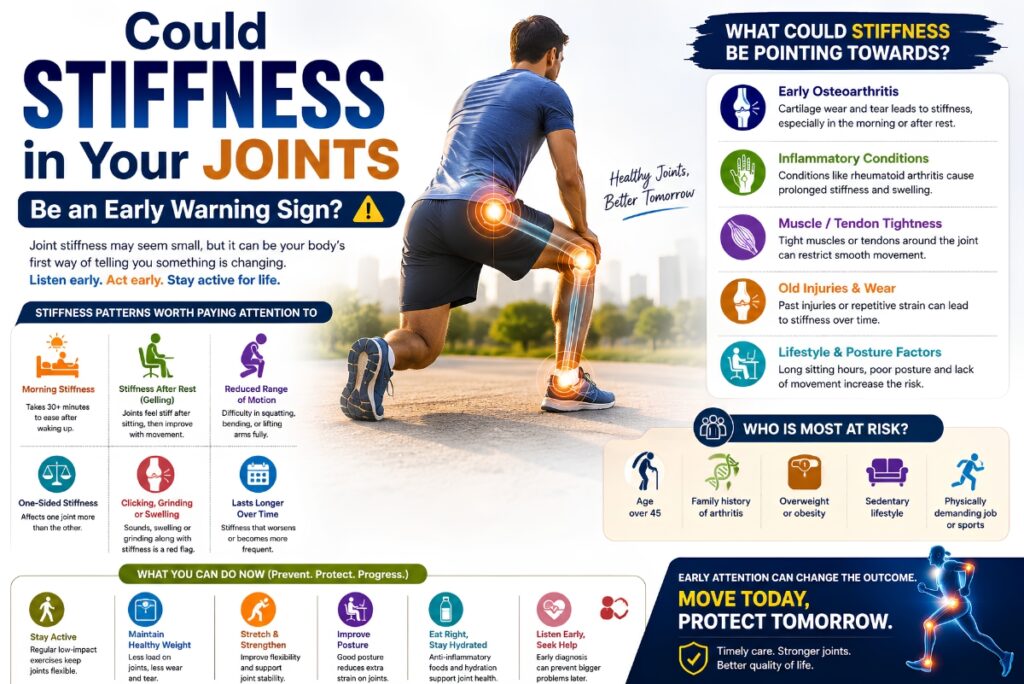
Could Stiffness in Your Joints Be an Early Warning Sign?
It starts small. A little stiffness in the knee when you get out of bed. A hip that feels tight after sitting through a long meeting. You stretch it out and walk around for a minute, and it eases. So you stop thinking about it.
This is exactly how most joint problems begin quietly, without urgency, easy to dismiss as just a normal part of getting older or sitting too long at a desk. But morning stiffness, when it becomes a regular pattern, is often the joint’s earliest way of telling you that something underneath is changing.
The question patients eventually ask, often after months or years of working around the stiffness, is whether they’re now looking at joint replacement surgery in Mumbai and whether things could have gone differently if they’d paid attention sooner.
The truthful answer is reassuring: in most cases, yes, things can go differently. Stiffness caught early rarely means surgery is your only path forward. As an orthopedic specialist who sees this progression regularly, Dr. Sanesh Tuteja wants every patient to understand what joint stiffness actually means, when it’s worth worrying about, and what can be done long before replacement surgery ever becomes necessary.
Why Joint Stiffness Happens in the First Place
Joints are remarkable structures. Cartilage cushions the bones, synovial fluid lubricates movement, and surrounding muscles and ligaments provide stability. When all of this works well together, movement feels effortless.
Stiffness develops when something in this system is disrupted even slightly. The most common underlying mechanisms include:
- Reduced synovial fluid circulation after periods of inactivity, particularly overnight sleep, leaving joints feeling tight until movement restores normal lubrication
- Early cartilage thinning, which reduces the smooth, cushioned movement between joint surfaces
- Low-grade inflammation within the joint capsule, often the earliest detectable sign of degenerative joint changes
- Muscle tightness and weakness surrounding the joint, which alters how forces are distributed during movement
- Mild swelling, sometimes too subtle to notice visually, that restricts the joint’s full range of motion
Occasional stiffness that resolves quickly with movement is common and usually not a cause for concern. The pattern becomes meaningful when it starts showing up consistently, lasts longer, or is joined by other symptoms.
The Stiffness Patterns Worth Paying Attention To
Morning Stiffness That Takes a While to Ease – A few minutes of stiffness after waking is normal. Stiffness that consistently takes 30 minutes or more to resolve, particularly in the knees, hips, or hands, is a recognized early indicator of joint changes, including early osteoarthritis.
Stiffness After Periods of Rest (“Gelling”) – If your joints feel stiff specifically after sitting for a while at a desk, during a long drive, or after a movie and then loosen up again once you start moving, this pattern (sometimes called gelling) is commonly seen in early-stage arthritis.
Stiffness With Reduced Range of Motion – If you notice you can’t squat as deeply as you used to, can’t fully straighten your knee, or can’t raise your arm overhead the way you once could, this points to a genuine mechanical change within the joint, not just a feeling of tightness.
Stiffness That’s Asymmetrical – Stiffness affecting one knee, hip, or shoulder significantly more than the other often suggests a localized issue, previous injury, uneven wear, or early degenerative change specific to that joint rather than general age-related stiffness affecting the whole body evenly.
Stiffness Combined With Clicking, Grinding, or Swelling – When stiffness is joined by a grinding sensation (crepitus), audible clicking, or visible swelling, this combination strongly suggests cartilage involvement and warrants a proper evaluation.
What Joint Stiffness Could Actually Be Pointing Towards
Early Osteoarthritis – This is, by far, the most common underlying cause of progressive joint stiffness, particularly in patients over 40. Osteoarthritis develops as the protective cartilage within a joint gradually wears down, reducing the cushioning between bones. Morning stiffness, gelling after rest, and a gradual reduction in range of motion are classic early signs often appearing well before significant pain develops.
Inflammatory Joint Conditions – Conditions like rheumatoid arthritis present differently from osteoarthritis, typically with symmetrical stiffness (affecting both hands, both knees, etc.), prolonged morning stiffness lasting over an hour, and accompanying fatigue or low-grade fever. These conditions need a different diagnostic and treatment pathway and should be identified early.
Tendon and Ligament Tightness – Sometimes stiffness isn’t coming from the joint surface itself, but from tightened tendons and ligaments around it, often due to muscle imbalances, previous minor injuries, or simply reduced activity levels. This type of stiffness responds particularly well to targeted physiotherapy.
Previous Injury Catching Up – A ligament sprain or meniscus injury from years ago, even one that seemed to heal completely, can leave subtle joint instability or altered movement mechanics that gradually accelerate wear in that joint. This is one of the more overlooked causes of stiffness that patients often don’t connect to an old injury.
Early Joint Degeneration From Repetitive Strain – Occupations or sports involving repetitive joint loading, frequent squatting, kneeling, running, or overhead movements can accelerate localized joint wear well before the age at which arthritis is typically expected.
Who Is Most at Risk of Progressive Joint Stiffness?
Certain factors make it more likely that stiffness represents an early degenerative process rather than simple, harmless tightness:
- Age over 45, when natural cartilage changes become more common
- Family history of arthritis or joint replacement, suggesting a genetic predisposition
- Previous joint injury, even if it seemed to fully heal at the time
- Excess body weight, which significantly increases load on weight-bearing joints like the knee and hip
- A history of high-impact sports, particularly those involving repetitive pivoting, jumping, or running
- Occupations requiring frequent kneeling, squatting, or heavy lifting
- Sedentary lifestyle, which weakens the muscles that support and stabilise joints
If two or more of these apply to you alongside regular stiffness, it’s worth getting the joint properly assessed rather than continuing to manage around it.
Treatment Options: Most Patients Never Need Surgery
This is the part many patients are relieved to hear: the vast majority of joint stiffness, when caught early, responds extremely well to non-surgical care.
Physiotherapy and Targeted Exercise – Strengthening the muscles around an affected joint, improving flexibility, and correcting movement patterns can significantly reduce stiffness and slow the progression of early degenerative changes. This is almost always the first and most effective line of treatment.
Joint Preservation Techniques – For patients with early cartilage changes, joint preservation approaches focus on protecting and restoring the natural joint rather than jumping ahead to replacement. These may include activity modification, structured rehabilitation, and, where appropriate, regenerative treatments aimed at supporting the joint’s own healing capacity.
Arthroscopic Evaluation and Treatment – When stiffness is linked to a specific structural issue, a meniscus tear, loose cartilage fragment, or ligament problem, minimally invasive arthroscopic procedures can directly address the underlying cause, often resolving stiffness that hasn’t responded to conservative treatment alone.
Sports Injury Rehabilitation – For stiffness traced back to a previous sports-related injury, an old ligament tear or meniscus issue, for example, a structured rehabilitation program tailored to the original injury can address the root mechanical cause rather than just the resulting stiffness.
Lifestyle and Weight Management – Reducing excess body weight measurably decreases load on weight-bearing joints, often producing significant improvement in stiffness and function without any other intervention.
Joint Replacement Surgery: When It Genuinely Becomes the Right Option
For patients with advanced cartilage loss, significant pain, and stiffness that no longer responds to conservative measures, joint replacement surgery can be genuinely transformative. Modern techniques, including robotic-assisted joint replacement, allow for highly precise implant positioning, better alignment, and a smoother overall recovery compared to traditional approaches. This option is considered only after appropriate non-surgical treatment has been tried, never as a first step.
The Real Benefit of Catching Stiffness Early – Patients who seek evaluation when stiffness first becomes a noticeable pattern rather than waiting until pain and disability set in consistently have more treatment options available to them.
Early evaluation typically allows for:
- Identification of cartilage wear before it progresses significantly
- A much wider range of non-surgical treatment options
- Correction of muscle imbalances before compensatory problems develop in other joints
- Slower disease progression through targeted, timely intervention
- A significantly reduced likelihood of eventually needing joint replacement at all
The joint you protect today is the mobility you preserve for years to come.
Don't Wait for Stiffness to Become a Bigger Problem
That stiff knee or tight hip you’ve been quietly working around isn’t something to ignore, but it’s also not something to panic about. It’s information your joint communicating a change, often well before any serious damage has occurred.
Most patients who address stiffness early avoid surgery altogether. Those who do eventually need joint replacement surgery typically have far better outcomes when the decision is made thoughtfully, with all conservative options properly explored first.
Dr. Sanesh Tuteja brings a joint-preservation-first approach to every patient, combining careful diagnosis with the full range of modern treatment options from physiotherapy and arthroscopy to advanced robotic joint replacement when it’s genuinely the right path.