
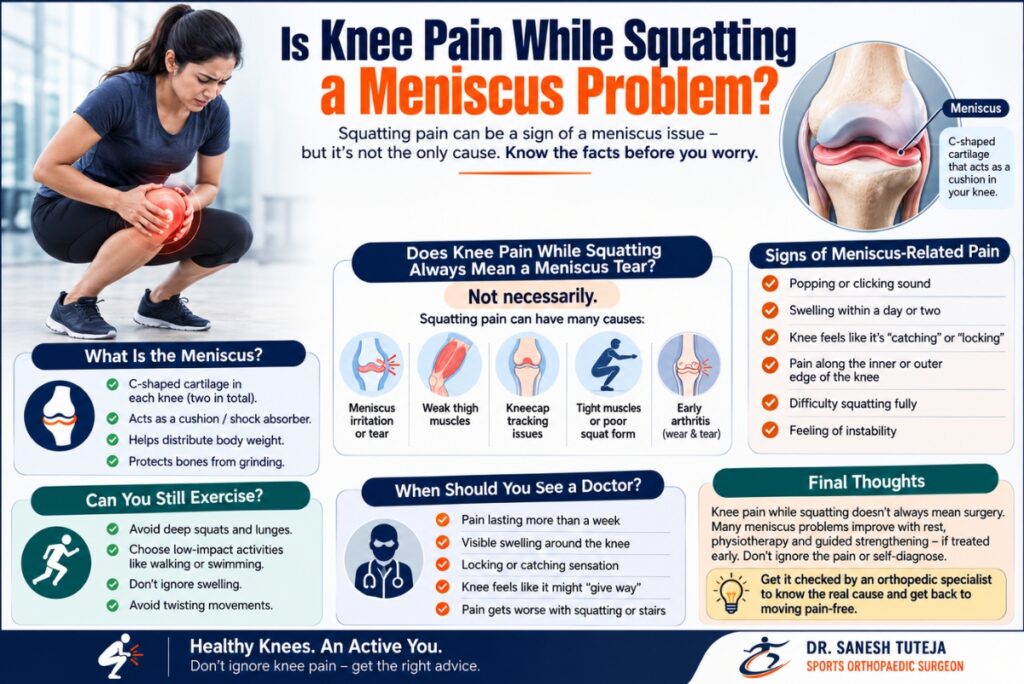
Is Knee Pain While Squatting a Meniscus Problem?
You bend down to pick something off the floor, or you’re halfway through a squat at the gym, and suddenly there’s a sharp twinge in your knee. It makes you pause and think, Is this just normal wear and tear or something more serious, like a meniscus tear?
It’s a fair question and one that comes up a lot. Let’s go through it in plain, simple language so you actually understand what might be going on.
What Is the Meniscus Anyway?
Before jumping to conclusions, it helps to know what we’re even talking about. The meniscus is a small, C-shaped piece of cartilage in your knee. You actually have two of them in each knee, sitting between your thighbone and shinbone.
Think of it like a cushion or shock absorber. Every time you walk, run, climb stairs, or squat, the meniscus helps distribute your body weight evenly and protects the bones from grinding against each other.
Because squatting puts a lot of bending pressure on the knee, it’s one of the movements most likely to bring meniscus-related pain to the surface, which is exactly why so many people connect the two.
Does Knee Pain While Squatting Always Mean a Meniscus Tear?
Here’s the honest answer: not necessarily. Squatting pain can come from several different sources, and the meniscus is just one possibility. Some common causes include:
- Meniscus irritation or tear – often felt as pain on the inner or outer side of the knee, sometimes with a clicking or catching sensation.
- Weak thigh muscles – if your quadriceps or hamstrings aren’t strong enough, your knee joint takes on extra load during squats.
- Kneecap tracking issues – where the kneecap doesn’t glide smoothly in its groove, causing pain at the front of the knee.
- Tight muscles or poor squat form – something as simple as your knees caving inward or your heels lifting off the ground can strain the joint.
- General wear and tear (early arthritis) – more common in people over 40, where the cartilage naturally thins over time.
So while a meniscus problem is a real possibility, it’s not the only explanation. That’s exactly why guessing at home isn’t the best approach.
What Does Meniscus-Related Pain Usually Feel Like?
If a meniscus issue is behind your squatting pain, there are usually a few telltale signs alongside it:
- A popping or clicking sound at the time of injury
- Swelling that shows up within a day or two
- A feeling that your knee is “catching” or “locking” when you try to fully bend or straighten it
- Pain specifically along the joint line (the inner or outer edge of the knee, not the front)
- Difficulty squatting all the way down, or a feeling of instability
If you’re nodding along to a few of these, it’s worth getting it looked at rather than pushing through your workouts and hoping it settles on its own.
Can You Still Exercise If You Suspect a Meniscus Problem?
This is where a lot of people get confused. A meniscus tear doesn’t always mean you need to stop moving completely, but it does mean you should stop guessing.
- Avoid deep squats and lunges until you know what’s actually going on.
- Switch to low-impact movements like walking or swimming in the meantime.
- Don’t ignore swelling it’s your body’s way of asking for rest.
- Avoid twisting motions on the knee, like sudden direction changes in sport.
Continuing to squat heavy with an irritated meniscus can sometimes make a small tear worse, which is why an early check-up matters more than pushing through the pain.
When Should You See a Doctor?
Not every knee twinge needs an urgent visit, but certain signs shouldn’t be ignored:
- Pain that lasts more than a week despite rest
- Visible swelling around the knee
- A locking or catching sensation when moving the knee
- Instability, like your knee feels like it might “give way.”
- Pain that gets worse specifically with squatting or stairs
If any of these sound familiar, it’s a good idea to get a proper treatment from a specialist who can examine the joint, check your range of motion, and if needed, recommend an MRI to look at the meniscus and surrounding structures clearly. Guesswork based on Google searches (however well-meaning) can’t replace a hands-on clinical assessment.
Final Thoughts
Knee pain while squatting can feel worrying, especially if it’s affecting your workouts or daily movement. But as Dr. Sanesh Tuteja often explains to patients, not every ache means surgery is around the corner; many meniscus issues respond well to rest, physiotherapy, and guided strengthening, especially when caught early. The key is not ignoring it and not self-diagnosing either. If squatting consistently triggers pain, clicking, or swelling, getting a proper evaluation from an orthopedic surgeon in Mumbai can help you understand exactly what’s going on and get you back to moving comfortably, without unnecessary worry.