
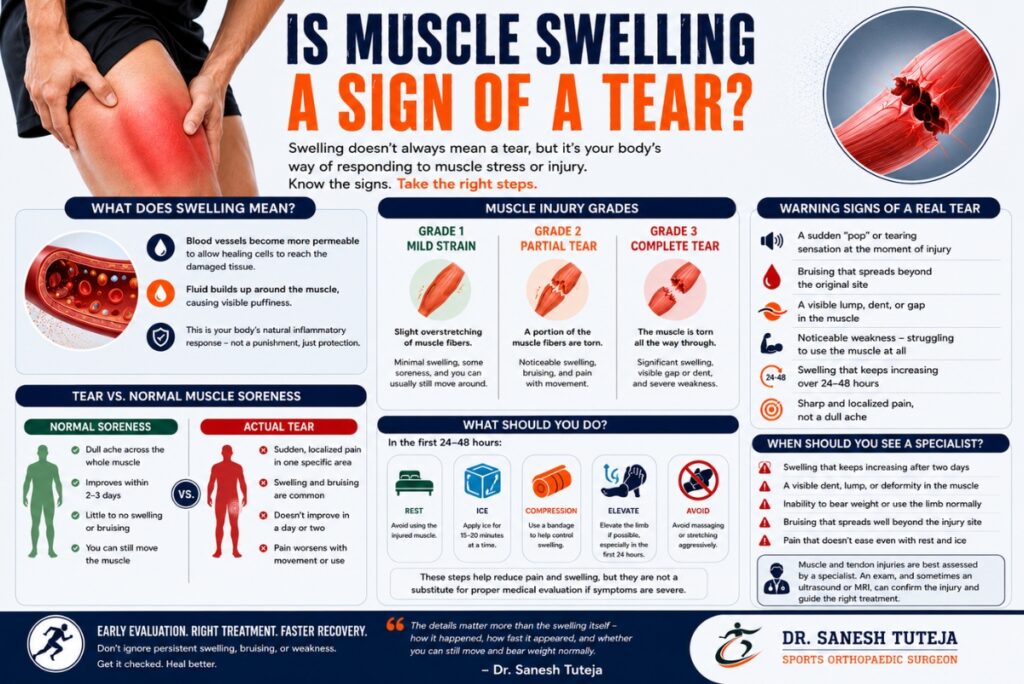
Is Muscle Swelling a Sign of a Tear?
You’re in the middle of a workout, a run, or maybe just picking up something heavy at home, and suddenly you feel a sharp pull in your muscle. A few hours later, the area looks puffy and tender. Naturally, the first thought that comes to mind is, “Is this a tear? Should I be worried?”
Muscle swelling can feel alarming, especially if you’ve never experienced it before. But swelling on its own doesn’t automatically mean you’ve torn something. Let’s break down what’s actually happening in your body and when it’s time to take it seriously.
What Does Swelling Actually Mean After a Muscle Injury?
Swelling is basically your body’s repair crew showing up at the scene. When muscle fibers get stressed, overstretched, or injured, your body sends extra blood and fluid to the area to start the healing process.
- Blood vessels near the injury become more permeable (a bit “leakier”) to let healing cells reach the damaged tissue.
- Fluid builds up around the muscle, causing visible puffiness.
- This is your body’s natural inflammatory response, not a punishment, just protection.
So swelling itself is a normal reaction to muscle stress. The real question isn’t whether you’re swelling, but how much, how fast, and what else is happening alongside it.
Does Every Muscle Tear Cause Swelling?
Not always, and this surprises a lot of people. Muscle injuries generally fall into three categories, often called grades:
- Grade 1 (mild strain): Slight overstretching of muscle fibers. Minimal swelling, some soreness, and you can usually still move around.
- Grade 2 (partial tear): A portion of the muscle fibers are torn. Noticeable swelling, bruising, and pain with movement.
- Grade 3 (complete tear): The muscle is torn all the way through. Significant swelling, often a visible gap or dent in the muscle, and severe weakness.
So yes, tears usually do cause swelling, but mild strains can cause swelling too, and severe tears sometimes show delayed swelling that appears a day or two later, not immediately.
What Are the Warning Signs That Point to a Real Tear?
Swelling alone isn’t the full picture. Here’s what tends to accompany an actual muscle tear, rather than just general soreness:
- A sudden “pop” or tearing sensation at the moment of injury
- Bruising that spreads beyond the original site, sometimes down the limb
- A visible lump, dent, or gap where the muscle should be smooth
- Noticeable weakness: struggling to use the muscle at all
- Swelling that keeps increasing over 24–48 hours instead of settling down
- Pain that’s sharp and localized, rather than a dull ache
If you experienced a specific moment where something “gave way,” followed by these signs, it’s more likely you’re dealing with an actual tear rather than simple muscle fatigue.
How Is This Different from Normal Muscle Soreness?
This is where a lot of confusion happens, especially for people who exercise regularly. Delayed onset muscle soreness (the stiffness you feel a day or two after a hard workout) is completely different from an injury.
- Normal soreness feels like a dull ache across the whole muscle, not one specific spot.
- It usually improves within 2–3 days on its own.
- There’s little to no visible swelling or bruising.
- You can still move the muscle, even if it feels tight.
A tear, on the other hand, tends to be sudden and localized and doesn’t really improve with a day or two of rest; if anything, it can look worse before it looks better.
What Should You Do If You Suspect a Tear?
If you notice swelling along with any of the warning signs mentioned above, here’s what generally helps in the first couple of days:
- Rest the area and avoid using the injured muscle.
- Ice it for 15–20 minutes at a time to reduce swelling.
- Compression with a bandage can help control fluid buildup.
- Elevate the limb if possible, especially in the first 24 hours.
- Avoid massaging or stretching the area aggressively; this can sometimes worsen a tear.
This approach buys you time and comfort, but it isn’t a substitute for a proper evaluation, especially if the swelling is significant or not improving.
When Should You See a Specialist?
It’s a good idea to get it checked rather than wait it out if you notice the following:
- Swelling that keeps increasing after two days
- A visible dent, lump, or deformity in the muscle
- Inability to bear weight or use the limb normally
- Bruising that spreads well beyond the injury site
- Pain that doesn’t ease even with rest and ice
Muscle and tendon injuries are common in sports and active lifestyles, and they’re best assessed by someone experienced in treating them. A proper clinical exam, and sometimes an ultrasound or MRI, can confirm whether it’s a mild strain or a more significant tear that needs structured treatment and rehabilitation.
Final Thoughts
Swelling after a muscle injury isn’t something to panic over, but it also isn’t something to brush off completely. As Dr. Sanesh Tuteja often tells patients, the details matter more than the swelling itself: how it happened, how fast it appeared, and whether you can still move and bear weight normally. If you’re dealing with persistent swelling, visible bruising, or weakness that isn’t improving, it’s worth getting a proper assessment from an orthopedic surgeon in Mumbai rather than waiting and hoping it resolves on its own. Early evaluation often means a simpler, faster recovery.