
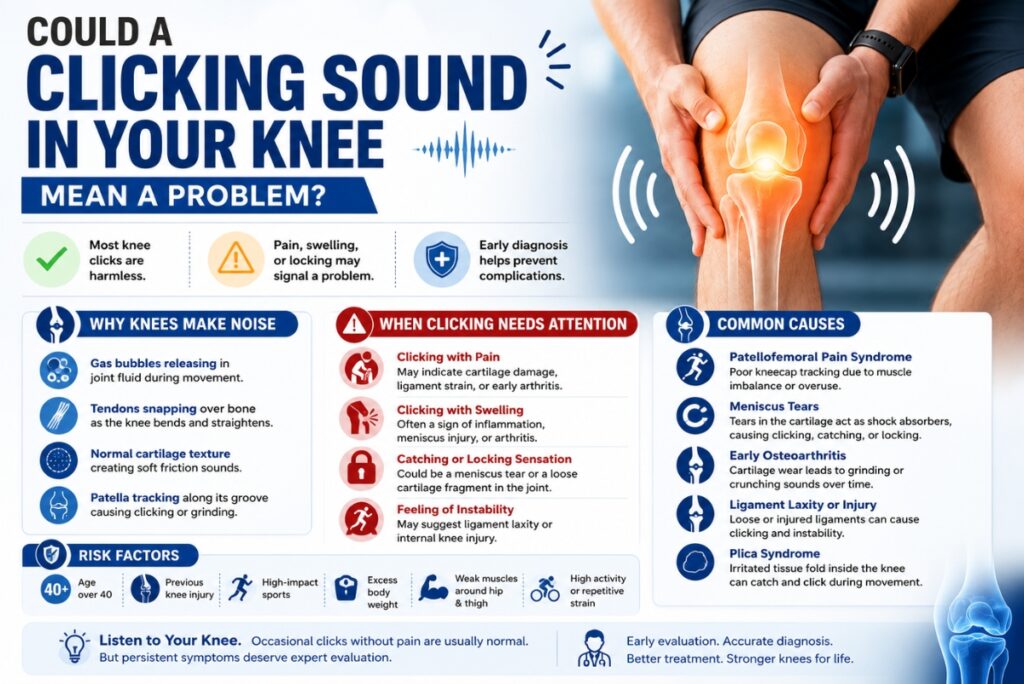
Could a Clicking Sound in Your Knee Mean a Problem?
You’re climbing the stairs or getting up from a low chair, and there it is, a distinct click from your knee. No pain, no warning. Just a sound that makes you pause for a second and wonder, should I be worried about this?
It’s one of the most common questions patients bring into orthopedic clinics across the city. Knees are noisy joints, and most of the time, that clicking is completely harmless, just gas bubbles shifting in the joint fluid or a tendon gliding over bone. But sometimes, that sound is the very first sign of something that needs attention.
The honest truth is that the answer depends on what else is happening alongside that click. Is there pain? Swelling? A feeling that the knee might give way? These details matter enormously, and understanding them is the first step toward knowing whether you need reassurance or knee pain treatment in Mumbai.
As an orthopedic surgeon who sees this exact concern regularly, Dr. Sanesh Tuteja breaks down what’s actually happening inside your knee when it clicks, pops, or crunches,and how to tell the difference between normal joint sound and a genuine warning sign
Why Knees Make Noise in the First Place
Before getting into when to worry, it helps to understand why knees are such noisy joints to begin with.
The knee is the largest and one of the most complex joints in the human body. It’s where the thigh bone (femur), shin bone (tibia), and kneecap (patella) meet, all held together and cushioned by ligaments, tendons, and two crescent-shaped pieces of cartilage called the menisci. With this many moving parts working together, some amount of sound is simply part of normal joint mechanics.
Common, usually harmless reasons your knee clicks:
- Gas bubbles releasing: Similar to cracking your knuckles, gas dissolved in the joint fluid can form bubbles that pop with movement, creating a clicking or popping sound
- Tendons snapping over bone: As you bend and straighten your knee, tendons can briefly catch and release over small bony prominences, producing a click
- Normal cartilage surface texture: The smooth cartilage surfaces inside the knee aren’t perfectly silent, and minor friction can create soft sounds during movement
- Patella tracking: As the kneecap glides along its groove during movement, slight irregularities in this path can cause a clicking or grinding sensation
If your knee clicks occasionally, without any pain, swelling, or sense of instability, this is generally not something to worry about. Many people experience this throughout their lives without ever developing a knee problem.
When Clicking Becomes a Signal Worth Listening To
The picture changes when clicking is joined by other symptoms. This is where the sound transitions from background noise to a genuine clue about what’s happening inside the joint.
Clicking With Pain – If every click or pop is accompanied by a sharp twinge or ongoing ache, this suggests something structural is involved, like irritated cartilage, a ligament under strain, or early wear within the joint.
Clicking With Swelling – A knee that swells after activity, especially alongside clicking, often points toward inflammation inside the joint. This can be due to cartilage irritation, meniscus involvement, or early arthritic changes.
Clicking With a “Catching” or “Locking” Sensation – If your knee occasionally catches mid-movement, feels like it’s about to lock, or genuinely locks and needs to be gently wiggled to release, this is a more specific sign, often associated with a meniscus tear or a loose fragment of cartilage within the joint.
Clicking With a Feeling of Instability – If your knee feels like it might give way, buckle, or “shift” during activities like walking on uneven ground or descending stairs, this can indicate ligament laxity or a more significant internal injury
What's Actually Causing the Clicking: Common Underlying Conditions
Patellofemoral Pain Syndrome (Runner’s Knee) – This is one of the most frequent causes of clicking combined with mild discomfort, particularly in younger, active patients. It occurs when the kneecap doesn’t track smoothly within its groove on the thigh bone, often due to muscle imbalances around the hip and thigh. The result is clicking, a grinding sensation, and pain that’s typically worse going up or down stairs.
Meniscus Tears – The menisci act as shock absorbers within the knee. A tear, whether from a sudden twisting injury or gradual wear over time, can cause a distinctive clicking, catching, or locking sensation. Meniscus tears are common in both younger athletes (from sports injuries) and older adults (from age-related degeneration).
Early Osteoarthritis – As the protective cartilage within the knee gradually wears down, the joint surfaces no longer glide as smoothly against each other. This produces a characteristic grinding or crunching sound, sometimes described as crepitus, particularly with bending and straightening movements. Early arthritis often presents with this sound well before significant pain develops.
Ligament Laxity or Injury – Ligaments, particularly the ACL (anterior cruciate ligament), provide stability to the knee joint. When a ligament is loose or has been previously injured, the bones of the knee may shift slightly during movement, producing both clicking sounds and a feeling of instability.
Plica Syndrome – A plica is a small fold of tissue lining the inside of the knee joint, left over from fetal development. In some people, this tissue becomes thickened or irritated and can catch between the joint surfaces during movement, producing a clicking sound, often accompanied by localized tenderness.
Risk Factors That Make Knee Clicking More Likely to Signal a Problem
Certain factors increase the likelihood that clicking represents an underlying issue rather than harmless joint noise:
- Age over 40: natural cartilage wear increases the likelihood of early osteoarthritis
- A history of knee injury , previous ligament sprains, meniscus tears, or fractures increase vulnerability to recurring mechanical symptoms
- High-impact sports participation , running, football, and similar sports place repetitive stress on knee structures
- Excess body weight , additional load on the knee joint accelerates cartilage wear and increases mechanical stress
- Occupations involving frequent squatting or kneeling: these positions place sustained pressure on the kneecap and surrounding cartilage
- Muscle weakness around the hip and thigh , particularly weak quadriceps or hip stabilisers, which affect how the kneecap tracks
If several of these apply to you alongside persistent clicking, it’s worth getting the joint properly assessed rather than waiting to see if symptoms develop further.
Treatment Options for Knee Clicking With an Underlying Cause
The right treatment depends entirely on the underlying cause, which is exactly why an accurate diagnosis matters so much before starting any treatment plan.
Physiotherapy and Strengthening – For conditions like patellofemoral pain syndrome and many cases of mild cartilage irritation, targeted physiotherapy is often the most effective first step. Strengthening the quadriceps, hip stabilizers, and core muscles improves how the kneecap tracks and reduces the abnormal forces contributing to clicking and discomfort.
Activity Modification – Temporarily reducing high-impact activities that aggravate symptoms, while maintaining low-impact movement like swimming or cycling, allows irritated structures to settle while preserving overall fitness and joint mobility.
Anti-Inflammatory Management – For cases involving inflammation, a short course of anti-inflammatory medication, combined with rest and ice, can reduce symptoms while a longer-term plan, like physiotherapy, takes effect.
Injections – For patients with more significant cartilage wear or inflammation, corticosteroid or viscosupplementation (lubricating) injections can provide meaningful symptom relief, often allowing physiotherapy to be more effective.
Arthroscopic Surgery – When a meniscus tear, loose cartilage fragment, or plica syndrome is causing persistent mechanical symptoms that don’t respond to conservative treatment, minimally invasive arthroscopic surgery can directly address the problem. This involves small incisions, a camera-guided approach, and typically a faster recovery than open surgery.
Why Early Evaluation Makes a Real Difference
Many patients delay seeking knee pain treatment because the clicking, by itself, doesn’t feel urgent. This is understandable, but it can mean missing the window where treatment is simplest and most effective.
Early evaluation allows the following:
- Identification of cartilage wear before it progresses to significant arthritis
- Treatment of meniscus tears before they enlarge or cause further joint damage
- Correction of muscle imbalances before compensatory patterns develop elsewhere in the leg or hip
- A wider range of treatment options, often avoiding the need for surgery altogether
The knee is a joint you rely on for nearly every daily movement. Catching a developing problem early protects both your mobility and your long-term joint health.
Listen to What Your Knee Is Telling You
A clicking knee isn’t automatically a cause for alarm. For most people, it’s simply one of the many sounds a healthy, well-used joint makes. But when that click is joined by pain, swelling, or a sense that something isn’t quite stable, it’s worth paying attention.
The good news is that most underlying causes of knee clicking, when caught early, respond very well to straightforward, non-surgical treatment. The key is not ignoring the combination of symptoms long enough for a manageable issue to become a more complicated one.
If you’ve been wondering whether that sound in your knee needs attention, Dr. Sanesh Tuteja offers expert knee pain treatment in Mumbai, with a thorough, patient-first approach to diagnosis and care.